
People camped outside Starbucks at 3am. Fights broke out in stores. Walmart and ALDI launched knockoffs within 48 hours. TikTok generated 20 million views. Starbucks, a company that rarely apologises for anything, had to issue a public statement.
All for a bear-shaped glass tumbler.
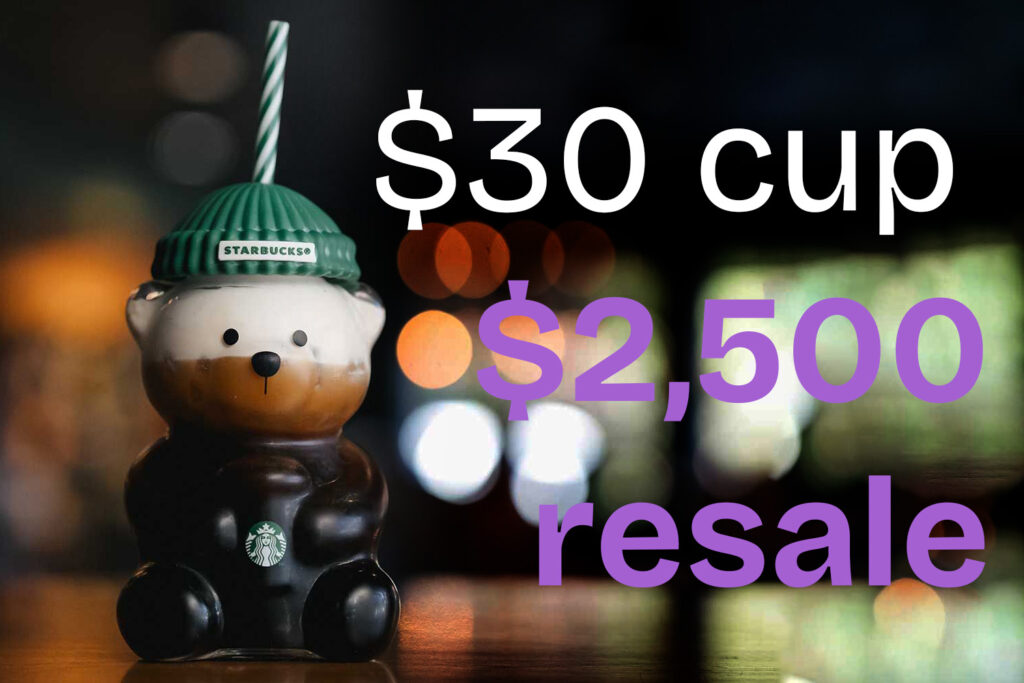
The Starbucks Bearista Cup is either the most brilliant product launch of 2025 or a masterclass in everything wrong with modern consumer culture.
Actually, it’s both.
I ran it through the SCULPT framework, my methodology for diagnosing why products fail or succeed. The score came back 13/24. But that number hides something more revealing: a product built with surgical precision to exploit psychological vulnerabilities while creating zero lasting value.
This is what happens when perfect execution meets catastrophic strategy.
WHAT HAPPENED
On 6 November 2025, Starbucks launched a limited-edition 20oz glass tumbler shaped like a honey bear wearing a green knit beanie. Retail price: $29.95.
It sold out nationwide within hours.
Some stores received just 1-2 units. By mid-afternoon, eBay listings hit $2,500. Social media erupted with videos of empty shelves, customer tears, and allegations that employees bought entire stock before stores opened.
Starbucks issued a rare apology acknowledging they « underestimated demand. » No restock was planned. Instead, they gamified 17,000 cups through a mobile app contest, turning scarcity into entertainment.
The secondary market exploded. Walmart launched $14 copies within 48 hours. ALDI trolled with « $4.99 gingerbread alternatives » and the tagline: « That Seattle-based coffee chain could neva. »
This wasn’t a supply chain failure.
This was by design.
THE FOMO ARCHITECTURE
Let’s be clear: Starbucks executed this flawlessly.
They understood that 70% of millennials experience FOMO regularly. They knew that TikTok amplifies collectible culture. They knew the « fun cup renaissance » (Stanley, Yeti, Owala) had primed the market. They knew holiday nostalgia + bear imagery creates emotional perfect storms.
They knew exactly what they were building.
What they didn’t predict, or didn’t care about, was the cascading consequences:
- Physical violence in stores
- Employee conflicts and theft allegations
- Brand damage requiring public apology
- Competitors turning their launch into a punchline
- Environmental theatre being exposed
This is comprehension without wisdom. First-order thinking without systems thinking.
They understood the market psychology. They didn’t understand what would happen when they weaponised it.
THE SCULPT BREAKDOWN
| Score | System | Comprehension | Utility | Longevity | PMF | Timing |
|---|---|---|---|---|---|---|
| 1 Critical |
Ecosystem is broken—creates more harm than value. Dependencies work against stated goals. | Fundamental misunderstanding of problem, users, or market. Operating on assumptions, not evidence. | No functional advantage over existing solutions priced at 1/10th the cost. Value is purely emotional signalling. Alternatives work better. | No durable value. Built for a trend moment, not to last. Forgotten within 24 months. | No genuine market pull. If demand exists, it’s forced through manipulation or hype. Competing solutions better serve real needs. | Catastrophically mistimed. Market infrastructure, culture, or technology hasn’t evolved to support this category—or has already moved past it. |
| 2 Warning |
Works but with friction. Unclear dependencies. Creates unintended negative consequences. | Understands first-order effects but misses second-order consequences. Can explain what happens but not why it matters. | Marginal improvement over alternatives with significant compromises. Regular usability friction. | Some lasting value but vulnerable to trends or tech shifts. 2-5 year horizon with declining relevance. | Niche demand exists but weak signals vs alternatives. Traction is inconsistent. More push than pull required. | Slightly mistimed. Category has potential but 1-2 major adoption barriers remain (regulation, infrastructure, behavior change). |
| 3 Functional |
Coherent with clear dependencies. Most parts work together. Some optimization opportunities remain. | Good understanding of problem and market. Can articulate the « why » behind decisions. Minor blind spots. | Clear functional advantage in primary use case. Usable with minor friction. Noticeably better than most alternatives. | Strong value proposition that transcends trends. Relevant 5+ years with minor evolution. | Clear market demand for THIS specifically vs alternatives. Product is pulled from market, not pushed. Growing traction. | Well-timed for category. Market is receptive to this type of solution. Infrastructure and behavior patterns support adoption. |
| 4 Excellence |
All parts reinforce each other. Creates positive externalities. System improves everything it touches. | Deep, holistic understanding. Anticipates second and third-order effects across the entire system. | Exceptional utility. Dramatically superior to all alternatives. Becomes the new standard. Usability is invisible. | Timeless value. Relevant 10+ years. Creates new category or redefines existing one. Generational impact. | Market desperately wants THIS specifically. Overwhelming pull vs alternatives. Customers become advocates. Competitors can’t keep up. | Perfect window. All external conditions aligned—cultural shifts, tech readiness, regulatory environment. Window open now, closing soon. |
SCULPT diagnoses products across six dimensions. Each scores 1-4 (Critical Failure to Excellence). The Bearista Cup scored 13/24.
But the distribution matters more than the total.
SYSTEM: 1/4 (Critical Failure)
The product is marketed as « reusable », Starbucks’ sustainability play.
But manufactured scarcity turned it into a collectible. Too precious to use. Too cute to risk breaking. So instead of replacing disposable cups, it:
- Triggered energy-intensive glass manufacturing for objects that won’t fulfil their purpose
- Created a secondary resale market requiring packaging and shipping
- Generated copycat production from Walmart, ALDI, and countless others
- Contradicted Starbucks’ 9,000 verified sustainable stores
The system amplifies environmental impact while claiming to reduce it.
This is sustainability theatre. The worst kind, because it works.
COMPREHENSION: 2/4 (Warning)
Starbucks understood FOMO. They understood scarcity drives urgency. They understood TikTok amplifies trends.
They didn’t understand second-order effects.
They knew what they were doing. They didn’t know what would happen.
This is the danger of optimization divorced from ethics. You can be brilliant at execution and catastrophic at outcomes.
UTILITY: 1/4 (Critical Failure)
It’s a 20oz glass cup.
You can buy functionally identical versions for $2 at any homeware store.
The Bearista Cup provides zero functional advantage. Its entire value proposition is:
- « I got one and you didn’t »
- « I’m part of the trend »
- « I have disposable income for branded collectibles »
It solves no problem. It improves no one’s life. It exists to be posted, not used.
$30 object with $0 function. Pure signalling.
LONGEVITY: 1/4 (Critical Failure)
Where will most Bearista Cups be in 2 years?
Storage. Goodwill. The back of a cupboard behind actually useful items.
The « fun cup renaissance » built lasting brands on genuinely better performance—Stanley’s thermal retention, Yeti’s durability, Owala’s spill-proof design. The Bearista Cup borrowed the cultural moment but delivered none of the substance.
Glass manufacturing is energy-intensive. The environmental cost is permanent.
The emotional value is temporary.
Manufactured to be forgotten. The opposite of sustainability.
PRODUCT-MARKET FIT: 4/4 (Strong)
Here’s the uncomfortable truth: this product has perfect market fit.
The evidence is overwhelming:
- Sold out in hours, nationwide
- 20M+ TikTok views in 48 hours
- $2,500 resale prices
- Physical fights over glass cups
- People camping at 3am for branded merchandise
People demonstrably want this. They want it badly enough to wake up before dawn, fight strangers, and pay 80x retail for emotional validation through branded glass.
This is textbook product-market fit.
The question isn’t whether it fits a market.
The question is: should that market exist?
TIMING: 4/4 (Strong)
November 2025 was the perfect moment.
Every trend aligned:
- Holiday nostalgia peak (bear = childhood, warmth, comfort)
- « Fun cup renaissance » already primed buyers
- TikTok collectible culture at maximum intensity
- Gift-giving season = impulse purchase justification
- Post-pandemic « treat yourself » mentality still strong
If they’d launched in March, it would have flopped. 2023? Too early. 2026? The trend will have moved on.
They threaded the needle with precision.
THE REAL PROBLEM
13/24 doesn’t tell the full story.
The Bearista Cup maxed out on market appeal, but failed miserably at everything else.
This is the anatomy of market-dysfunction fit.
When a product scores perfectly on « does the market want this » and catastrophically on « should this exist, » you’ve found a market failure, not a market opportunity.
Modern product culture celebrates the former and ignores the latter.
WHAT THIS REVEALS ABOUT PRODUCT CULTURE
The Bearista Cup is a mirror.
It reveals an industry that:
Optimizes for engagement over impact
20M TikTok views matter more than whether anyone uses the product in 6 months.
Confuses manipulation with understanding
Exploiting FOMO psychology isn’t the same as understanding user needs.
Weaponizes sustainability as marketing
« Reusable » becomes a signal, not a practice. The environment is a brand, not a constraint.
Celebrates perfect execution regardless of strategy
Flawless timing and distribution of something worthless is still worthless.
Treats market dysfunction as market fit
People camping overnight and fighting over branded glass isn’t demand discovery—it’s manufactured desperation.
This is what peak consumerist culture looks like.
Not the failure to create demand, but the success in creating demand for something fundamentally worthless.
THE LESSON FOR PRODUCT BUILDERS
Perfect market fit doesn’t mean you’ve built something worth building.
Flawless timing doesn’t validate the strategy.
Overwhelming demand doesn’t prove value.
When SCULPT reveals 4/4 on PMF and Timing but 1/4 on System, Utility, and Longevity, you haven’t achieved product-market fit.
You’ve achieved market-dysfunction fit.
The Bearista Cup will:
- Generate more revenue in resale markets than Starbucks will ever see
- Create more waste than it prevents
- Be forgotten faster than the time people spent queuing for it
- Stand as proof that perfect execution can create terrible outcomes
But for a brief moment in November 2025, it was perfect.
THE UNCOMFORTABLE QUESTION
The scary part isn’t that Starbucks did this.
The scary part is that it worked.
The scary part is that we live in a product culture where this is celebrated as brilliant rather than critiqued as dystopian.
The scary part is that « market-dysfunction fit » is now a viable business model.
The Bearista Cup reveals that the market will reward you for building things that:
- Don’t solve problems
- Won’t last
- Damage the environment
- Exploit psychological vulnerabilities
- Create zero lasting value
As long as you execute flawlessly.
That’s not a product culture. That’s a problem culture.
WHAT NOW?
If you’re building products, ask yourself:
Does perfect market fit make this worth building?
Or are you just finding demand for dysfunction?
Does flawless execution validate the strategy?
Or are you optimizing towards the wrong outcome?
If you score 4/4 on PMF and 1/4 on everything else, have you succeeded?
Or have you just built something the market wants that shouldn’t exist?
The SCULPT framework forces these questions.
Because sometimes the most important thing to learn about your product isn’t how to make it succeed.
It’s whether it deserves to.
Enjoyed this in-depth analysis?